

Halloween Accidents in Florida
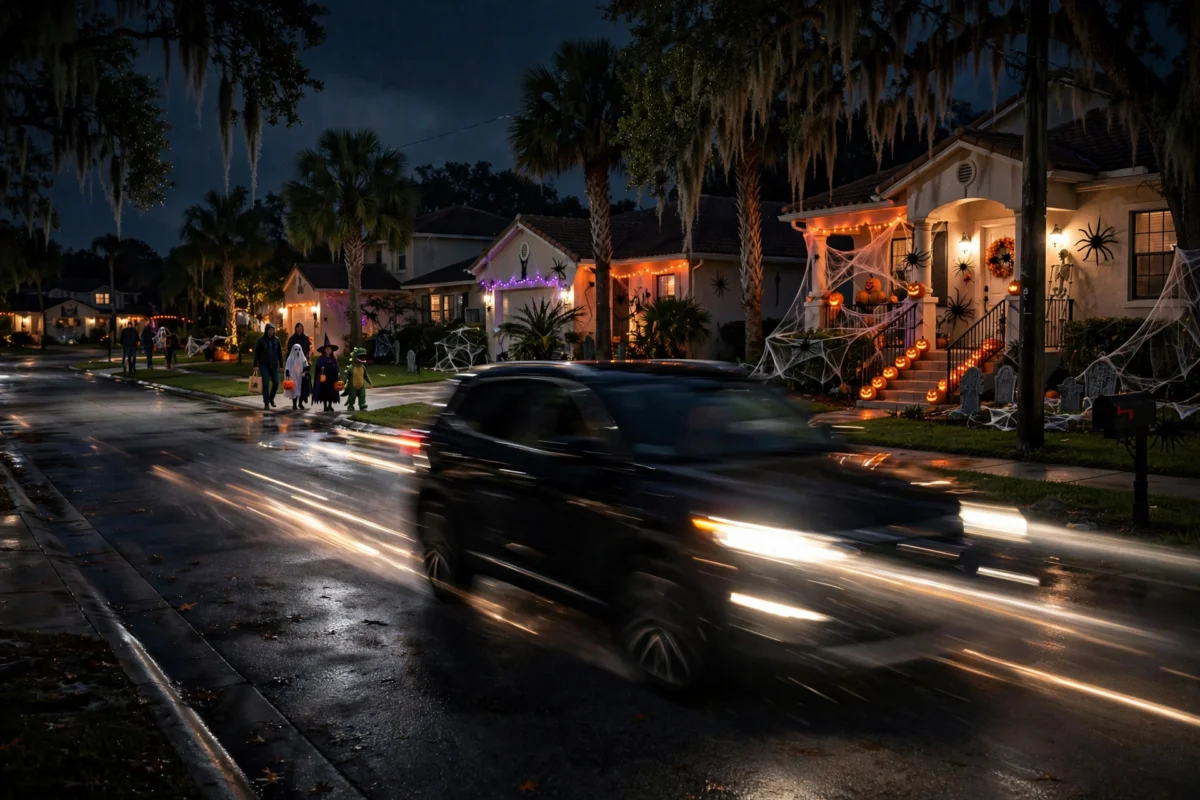
Halloween pedestrian accidents in Florida make October 31 the most dangerous night of the year for children: more kids are hit by cars on Halloween than on any other night — and the biggest threat is the drunk or speeding driver racing through your neighborhood while families in costumes fill the sidewalks.
Is Halloween really the most dangerous night for children in Florida?
Yes. Halloween is the most dangerous night of the year for child pedestrians. A study published in JAMA Pediatrics, reviewing more than four decades of fatal U.S. crashes, found that the risk of a pedestrian being killed on Halloween evening is 43% higher than on other fall evenings — and for children ages 4 to 8, about 10 times higher than on a normal night. Florida is no exception. On Halloween 2022 alone, Florida roads saw 2,590 crashes, 137 serious injuries, and 21 deaths (FLHSMV), most around 7 p.m. — right in the middle of trick-or-treating. Nationally, about 76% of pedestrian deaths happen in the dark. And it is why Halloween pedestrian accidents in Florida deserve a plan before October 31 — not just a warning. The hardest part: most of these crashes are preventable. Halloween turns deadly when a driver drinks at a party and gets behind the wheel anyway, or speeds through a residential community — while children in masks and bulky costumes can’t see well, can’t move fast, and can’t react in time.Why Do Halloween Pedestrian Accidents in Florida Happen Every Year?
Halloween combines almost every risk factor for a pedestrian crash at the same time:- Darkness at peak hours. Trick-or-treating peaks between 6 p.m. and 9 p.m., when it is already dark and drivers are rushing home or out to parties.
- Costumes that limit vision and movement. Masks narrow what children — and parents in costume — can see, and long, bulky outfits make it hard to run, dodge, or get up fast in an emergency.
- Excitement and sudden moves. Children run between houses, cross mid-block, and dart out from between parked cars.
- Drunk and speeding drivers. Some drivers leave Halloween parties after drinking and speed through the same streets where families are out asking for candy.
- Neighborhoods not built for crowds. Many Florida neighborhoods have no sidewalks, poor lighting, and cars parked on both sides of the street.
The Real Threat on Halloween: Irresponsible Drivers in Your Neighborhood
Let’s be specific about who creates the danger. It is not the families walking door to door, and it is not the children in their costumes. It is the driver who drank too much at a Halloween party and drives through your community anyway — and the driver who treats a residential street like a highway while entire families cross with candy bags in hand. Alcohol slows reaction time and ruins judgment of speed and distance. Speed does the rest: according to the AAA Foundation for Traffic Safety, a pedestrian’s average risk of death is about 10% when struck at 23 mph, but about 50% at 42 mph. In a neighborhood, that is the difference between a scare and a funeral. And the child in front of that car is wearing a mask that limits what he can see and a costume that limits how fast he can move. He cannot save himself from someone else’s irresponsible choice — the driver is the one who can prevent it.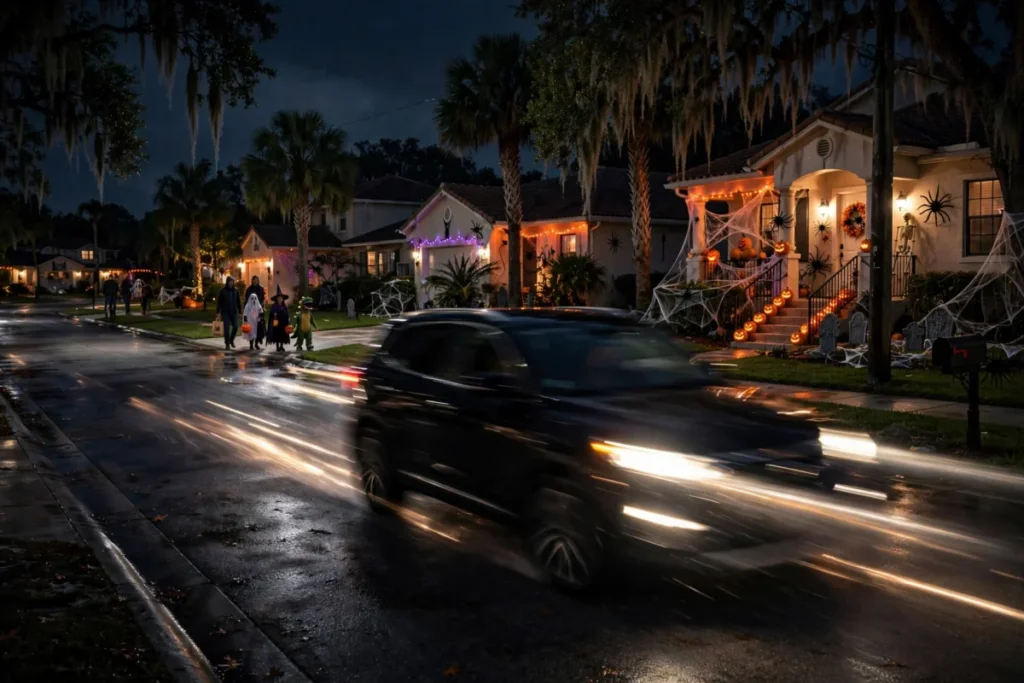
What Does Florida Law Say About Drivers and Pedestrians on Halloween?
Florida’s pedestrian statute, Florida Statute § 316.130, sets duties for both sides. Drivers must yield the right of way to a pedestrian in a crosswalk (subsection 7), and every driver must exercise due care to avoid colliding with any pedestrian, exercising proper precaution upon observing any child (subsection 15). “The child came out of nowhere” is no automatic defense for a speeding or distracted driver in a neighborhood full of trick-or-treaters.
Pedestrians crossing outside a crosswalk must yield to vehicles (subsection 10), and fault is decided case by case under Florida’s comparative negligence rules — which is why the evidence gathered in the first hours matters so much.
Is the Law Different in Fort Lauderdale, Tampa, or Sarasota?
No. Florida’s pedestrian law is state law: Florida Statute §316.130 applies the same way in Fort Lauderdale, Tampa, and Sarasota. What changes from city to city is not the law — it is the local risk.
Fort Lauderdale and Broward County. In the state’s most recent bicycle and pedestrian safety enforcement program, Broward County recorded 21 crashes with serious injuries or deaths involving pedestrians and cyclists — and Fort Lauderdale police alone handled 13 of them. Beach traffic, nightlife corridors, and neighborhoods without sidewalks make Halloween night especially dangerous here.
Tampa and Hillsborough County. Hillsborough recorded 22 serious or fatal bicycle and pedestrian crashes in the same program, the highest of Justice Law’s three office regions — and Halloween fills Tampa’s event districts and downtown streets with costumed pedestrians after dark.
Sarasota. The Sarasota metro area ranks among the deadliest in the nation for pedestrians, and Sarasota County had already logged 87 pedestrian crashes and 4 pedestrian deaths in the first half of 2026 (FLHSMV). With 38% of residents over 65 — the age group most likely to die when struck — Sarasota families face a risk that is easy to underestimate.
Wherever your family trick-or-treats in Florida, the duties are the same — and so are your rights after a crash. Justice Law handles these cases from its offices in Plantation, Tampa, and Sarasota.
How Can Drivers Avoid Hitting a Trick-or-Treater?
- Slow down in neighborhoods. Drive below the limit between 5:30 p.m. and 9:30 p.m., and treat every community street like a school zone — on Halloween, it is one.
- Put the phone away. No text, photo, or GPS check matters more than watching for small pedestrians.
- Turn headlights on early. They help you see children in dark costumes — and help them see you.
- Enter and exit driveways slowly. Children walk right behind cars on sidewalks and driveways.
- Never drive impaired — plan before the first drink. Rideshare, taxi, or a designated driver. Driving drunk through a trick-or-treating neighborhood risks a DUI and full civil liability for every injury you cause.
How Can Parents Keep Trick-or-Treaters Safe This Halloween?
- Make them visible. Reflective tape or glow sticks on costumes and candy bags, and a flashlight for each child.
- Choose face paint over masks. Masks block peripheral vision; face paint lets children see cars coming.
- Check that the costume lets them move. Test walking, turning, and climbing a step before you leave. Long capes, trailing fabric, and oversized shoes trip children and slow them down exactly when they need to react fast. Parents in costume: if you can’t see well, you can’t protect your child.
- Walk with children under 12. They should never trick-or-treat alone or cross streets by themselves.
- Plan a lit, familiar route. Sidewalks where they exist, cross at corners and crosswalks, and make eye contact with drivers before crossing.
- Review the rules before leaving. No darting between parked cars, no running into the street, and no phone screens while walking.

What Should You Do If a Child Is Hit by a Car on Halloween in Florida?
The minutes after a crash protect both your child’s health and your legal claim:
- Call 911 immediately. Even if the injury “seems minor” — children’s injuries are often worse than they look.
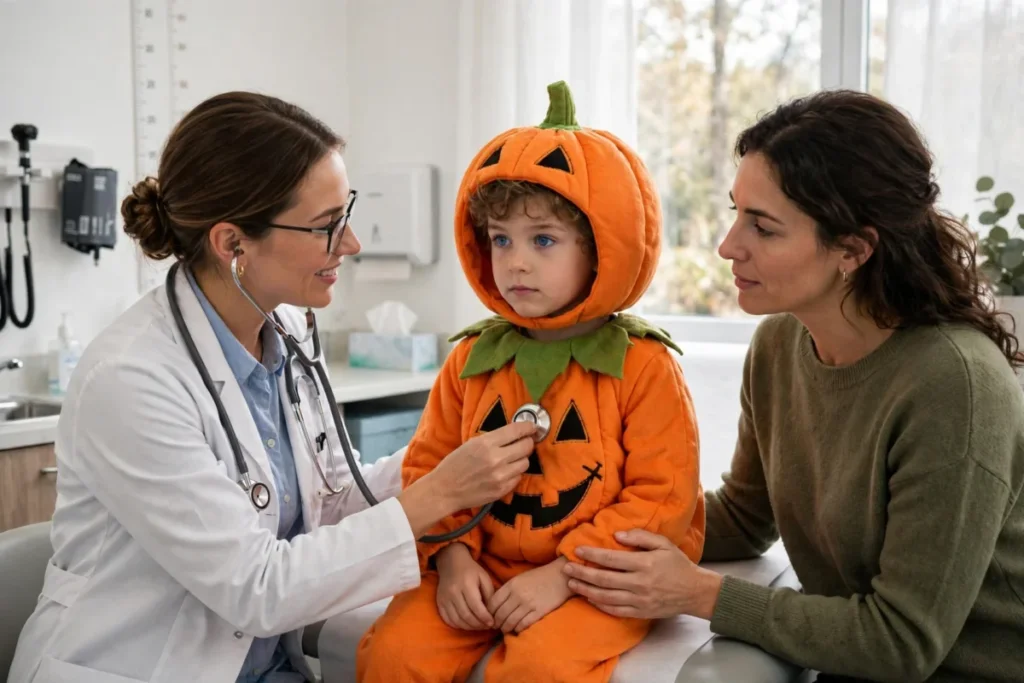
- Get medical care the same night. Go to the emergency room or urgent care, and describe every symptom.
- Document everything. Take photos of the scene, the vehicle, the costume, the lighting, and the injuries; note the driver’s insurance information; record witness names.
- Preserve the evidence. Keep the costume, shoes, and candy bag unwashed, and request the crash report — FLHSMV crash reports and fast evidence preservation can decide a case.
- Do not give a recorded statement. Adjusters may call within hours; you are not required to give one before speaking with a lawyer.
Halloween pedestrian accidents in Florida follow the same PIP and liability rules as any other crash — with one deadline you cannot miss.
One deadline is critical: under Florida’s 14-day PIP rule, an injured person must get medical treatment within 14 days of the crash to use Personal Injury Protection (PIP) benefits. Waiting “to see if it gets better” can cost your family thousands of dollars in coverage.

Can a Homeowner Be Liable If a Child Is Injured While Trick-or-Treating?
Yes, in some cases. A homeowner who invites trick-or-treaters onto the property must keep the walkway reasonably safe: adequate lighting, no hidden trip hazards, cords and decorations out of the path, and dogs secured. A serious injury caused by a dangerous condition can support a premises liability claim, in addition to any claim against a driver.
Halloween Pedestrian Accidents in Florida? Justice Law Fights for You
If your child was hit by a car on Halloween — or injured on someone’s property while trick-or-treating — don’t fight an insurance company alone. At Justice Law, we are trial lawyers: we prepare every case for trial from day one, we do not accept quick, low settlements, and you have direct access to your attorney.
Call 24/7: 954-515-5656 for a free case evaluation. Email: justice@justiceinjurylawyer.com — justiceinjurylawyer.com. No fee unless we win.
This article provides general information about Florida law and is not legal advice. Every case is different; speak with an attorney about your specific situation.
Statewide Legal Powerhouse
- South Florida: 8551 W Sunrise Blvd. Plantation, FL 33322
- Gulf Coast (Sarasota): 49 N East Avenue, Sarasota, FL 34237
- Tampa: 14502 N. Dale Mabry Hwy Suite 200 Tampa, FL 33618
Call 24/7: 954-515-5656
The images appearing in this publication are dramatizations and illustrative reenactments created solely for editorial purposes. They do not depict actual crash scene evidence, judicial case records, or the individuals involved, in strict observance of confidentiality and out of respect for the victim’s family. Past case results and jury verdicts do not guarantee, warrant, or predict a similar outcome in future legal matters.

